


Page 5 - Annual Review 2018/2019
P. 5
Message from the

             Chairman


             Shipowners nowadays face a variety of environmental   its Members with more than 2,200 registered ships out
             challenges and rapid technological developments. They   of a global dry bulk fleet exceeding 11,000 ships. 25% of
             have to keep their operations cost competitive in order   the global dry bulk fleet basis deadweight is entered with
             to continue serving the needs of world seaborne trade   INTERCARGO.
             without  sacrificing  basic  requirements.  In  this  context,
             INTERCARGO’s three reference pillars of safety, efficiency,   An enthusiastic and effective INTERCARGO Secretariat is
             and environmental soundness, together with our constant   there to serve our present and future Members.
             aim  for  “quality  &  operational  excellence”  remain  more   If  not  already  a  Member,  we  really  look  forward  to
             relevant than ever.                              welcoming you aboard!


             On  1  January  2020  when  the  fuel  oil  “Sulphur  Limit”
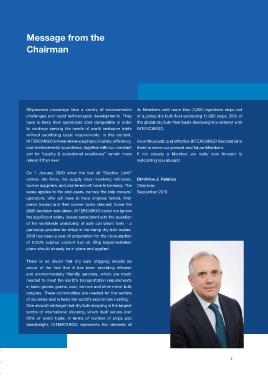
             comes  into  force,  the  supply  chain  involving  refineries,   Dimitrios J. Fafalios
             bunker suppliers, and charterers will have to be ready. The   Chairman
             same applies to the end-users, namely the ship owners/  September 2019
             operators,  who  will  have  to  have  engines  tested,  their
             crews trained and their bunker tanks cleaned. Since the
             2020 decision was taken, INTERCARGO could not ignore
             the significant safety issues associated with the question
             of the worldwide availability of safe compliant fuels - a
             particular problem for ships in the tramp dry bulk trades.
             2019 has been a year of preparation for the consumption
             of 0.50% sulphur content fuel oil. Ship implementation
             plans should already be in place and applied.


             There is no doubt that dry bulk shipping should be
             proud  of  the  fact  that  it  has  been  providing  efficient
             and  environmentally  friendly  services,  which  are  much
             needed to meet the world’s transportation requirements
             in basic goods: grains, coal, iron ore and other minor bulk
             cargoes. These commodities are needed for the welfare
             of societies and to keep the world’s economies running.
             One should not forget that dry bulk shipping is the largest
             sector of international shipping, which itself serves over
             90%  of  world  trade,  in  terms  of  number  of  ships  and
             deadweight. INTERCARGO represents the interests of


                                                                                                       3

