TOPICS & ISSUES

Maritime Security

Protecting Vessels, Crews, and Critical Systems at Sea

Maritime security remains a critical concern for the dry bulk sector. INTERCARGO monitors and addresses a broad spectrum of threats, from piracy and armed robbery in high-risk regions to the growing risks of cyberattacks targeting vessel systems and shore-based infrastructure. The Association works closely with international bodies and member companies to raise awareness, promote industry best practices, and support the implementation of practical measures that keep ships, crews, and operations secure.

Cyber Security

Read More

The International Maritime Organization (IMO) adopted a resolution, ‘Maritime Cyber Risk Management in Safety Management Systems (res MSC.428(98)’, in June 2017. An updated version of the IMO circular MSC-FAL.1/Circ.3/Rev.3, revised Guidelines on maritime cyber risk management, was approved by MSC 108 in May 2024, pending concurrent approval by the IMO Facilitation Committee in 2025. It provides high-level recommendations on maritime cyber risk management to safeguard shipping from current and emerging cyber threats and vulnerabilities. It also includes functional elements that support effective cyber risk management appropriately addressed in the existing Safety Management Systems (SMS) of a shipping company.

INTERCARGO members are actively involved in supporting the implementation of this resolution, and regularly share experiences via the channels established by the Association to assist members in complying with the relevant IMO requirements in the area of cyber security.

INTERCARGO continues to be involved in the development of the Industry Guidelines on Cyber Security Onboard Ships, first published in 2016. Version 5 of the Guidelines is expected to be published in December 2024. The Industry Guidelines are designed to develop an understanding and awareness of key aspects of cyber security and cyber safety. IMO issued circular MSC.1/Circ.1639 on 14 June 2021 which drew the attention to the industry Guidelines when addressing cyber risks on ships, in accordance with the objectives and functional requirements of the ISM Code, as encouraged by resolution MSC.428(98).

Piracy

Read More

INTERCARGO and its partner Round Table shipping associations have actively participated and promoted through the IMO and elsewhere, Best Management Practices (BMP’s) which give advice to Masters and Companies on how best to avoid seizure by Pirates.  These matters are kept under review by a small dedicated INTERCARGO Correspondence Group comprised of INTERCARGO Bulk Carrier companies who assist and advise the secretariat and Executive Committee on anti-piracy strategy and reaction to proposed policy developments.

INTERCARGO Policy

  • To work within the Round Table and the IMO / United Nations to end piracy in the Gulf of Aden and elsewhere.
  • To receive reports from members on their response to the situation, including possible operational responses such as routing via the Cape and BMP practices designed to deter attacks.
  • To stress to all authorities, the need to maintain sufficient naval capability to support the UN objectives of stabilising the region and supporting the World Food Programme, where INTERCARGO members have a strong involvement in securing humanitarian aid to the region.
  • To seek every available means to secure a safe release of all  seafarers held hostage and to bring the pirates to justice.
  • The safety of seafarers remains INTERCARGO’s prime concern.

Security

Read More

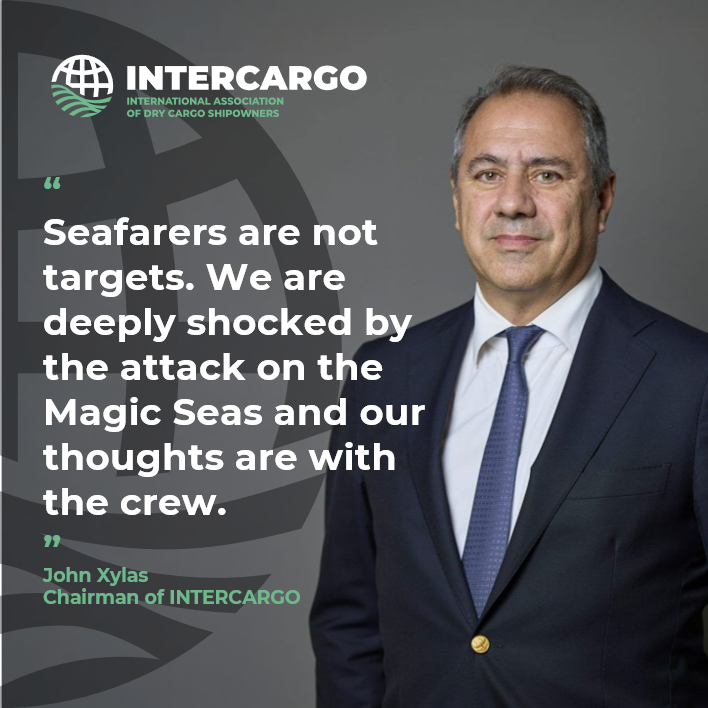
Global maritime security remains a critical concern for the dry bulk shipping sector, with ongoing threats such as piracy, armed attacks, and geopolitical instability in regions like the Red Sea, Gulf of Aden, and Black Sea (Ukraine). Recent years have seen a surge in attacks on merchant shipping, including Houthi missile and drone strikes in the Red Sea and disruptions to grain exports from Ukraine due to conflict. These incidents have resulted in tragic loss of life, vessel losses, and significant impacts on global trade and seafarer welfare. INTERCARGO is deeply engaged in addressing the evolving security threats facing the dry bulk shipping sector, including those arising from the conflict in Ukraine, Houthi attacks in the Red Sea and Gulf of Aden, and broader geopolitical instability.

Red Sea & Houthi Attacks:
Since late 2023, INTERCARGO has closely monitored and responded to the escalation of Houthi attacks on merchant shipping in the Southern Red Sea and Gulf of Aden. The association has participated in joint industry submissions to the IMO, unequivocally condemning attacks on civilian seafarers and ships, and calling for international action to safeguard freedom of navigation. INTERCARGO has provided members with regular security updates, risk assessments, and best practice guidance, including recommendations to use the Maritime Security Transit Corridor (MSTC), maintain communication with naval coordination centers (such as UKMTO and EUNAVFOR ASPIDES), and implement vessel hardening and reporting protocols. The association has also hosted webinars with naval forces (e.g., EUNAVFOR ASPIDES) to keep members informed of the latest developments and protective measures.

INTERCARGO’s analysis highlights the tragic loss of life and disruption to global trade caused by these attacks, with several bulk carriers lost and seafarers killed or taken hostage. The association continues to advocate for robust international naval presence, coordinated industry response, and long-term regional solutions to restore maritime security in the Red Sea and surrounding waters.

Ukraine Conflict:
INTERCARGO has been proactive in supporting the safety and welfare of seafarers and vessels affected by the conflict in Ukraine and the Black Sea region. The association co-sponsored submissions to the IMO, proposing practical solutions such as the establishment of safe corridors, humanitarian evacuation routes, and the condemnation of harassment of seafarers based on nationality. INTERCARGO has also called for the creation of mine-free sea corridors protected by naval escorts, and for the prioritization of crew changes, medical assistance, and the smooth operation of port state controls in Ukrainian ports.
The association has maintained ongoing engagement with the Joint Coordination Centre (JCC) overseeing the Black Sea Grain Initiative, providing guidance to members and supporting the safe export of essential cargoes from Ukrainian ports. INTERCARGO continues to monitor the situation, share updates, and advocate for the protection of seafarers and the uninterrupted flow of global trade.

Advocacy and Industry Coordination:
INTERCARGO regularly participates in high-level industry and naval briefings, collaborates with international partners, and disseminates timely security alerts and recommendations to its members. The association’s efforts are focused on ensuring the safety of seafarers, the security of vessels, and the resilience of global supply chains in the face of ongoing and emerging maritime threats.